
Duval County Sex Offender Checks
The Florida Sexual Offenders and Predators Search is the main public channel for Duval County sex offender records. FDLE offers four entry points: Offender Search, Neighborhood Search, University/Campus Search, and Internet Identifier Search. A person who knows a name can start broadly and compare aliases, birth date, physical traits, and addresses. Someone checking an area can instead enter an address, city, ZIP code, and radius. The campus tool serves a distinct location search, while the identifier tool checks an email address or other internet identifier without returning offender names.
The Jacksonville Sheriff's Office supplies registration and verification information from Duval County to the state system. Updates depend on partner-agency reporting, so note the source and received date shown with an address. FDLE warns that it does not independently verify every supplied fact. A photo or similar name is not positive identification. Fingerprints remain the reliable way to establish that two records concern the same person.
Four Duval Registry Search Routes
The best search route follows the question. Name search is useful when identifying details are already known. Neighborhood search is better for safety planning near a home or frequent destination. Campus search narrows the setting to a college or university. Internet Identifier Search answers whether an identifier appears in registry data, but its results intentionally do not disclose offender names.
Do not guess at controls that the live system does not expose. In particular, the neighborhood page includes a radius dropdown, yet the available radius values can change and must be confirmed in the live interface. Start broad enough to avoid losing a relevant result, then narrow with reliable details. Spellings, aliases, and temporary or transient addresses can affect what appears.
Florida Registry Searches
FDLE manages the statewide registry and publishes Duval County entries received through criminal-justice partners. The following sequence keeps the search tied to official information and reduces mistaken matches:
- Open the FDLE registry and choose the name, neighborhood, campus, or internet-identifier search.
- Enter only known criteria. For a neighborhood, provide the address, city, ZIP code, and a live radius choice.
- Compare plausible results by aliases, date of birth, physical description, status, and address source.
- Open the full profile, read the qualifying offense and dates, then use the alert link if tracking changes is useful.
| Field Label | Type | Required | Notes |
|---|---|---|---|
| First and Last Name | Text | Search route dependent | Use known aliases or spelling variants when needed. |
| Address | Text | Neighborhood search | Pair with city and ZIP for a location search. |
| City and ZIP Code | Text | Neighborhood search | Helps focus results on Duval County locations. |
| Radius | Dropdown | Neighborhood search | Confirm current options in the live interface. |
| Campus Criteria | Dynamic controls | Campus search | Options must be checked interactively. |
| Internet Identifier | Text | Identifier search | Results do not disclose offender names. |
The official FDLE search form shows how these distinct routes are presented. Its separate controls matter because a neighborhood query should not be treated as a name-based identity check.
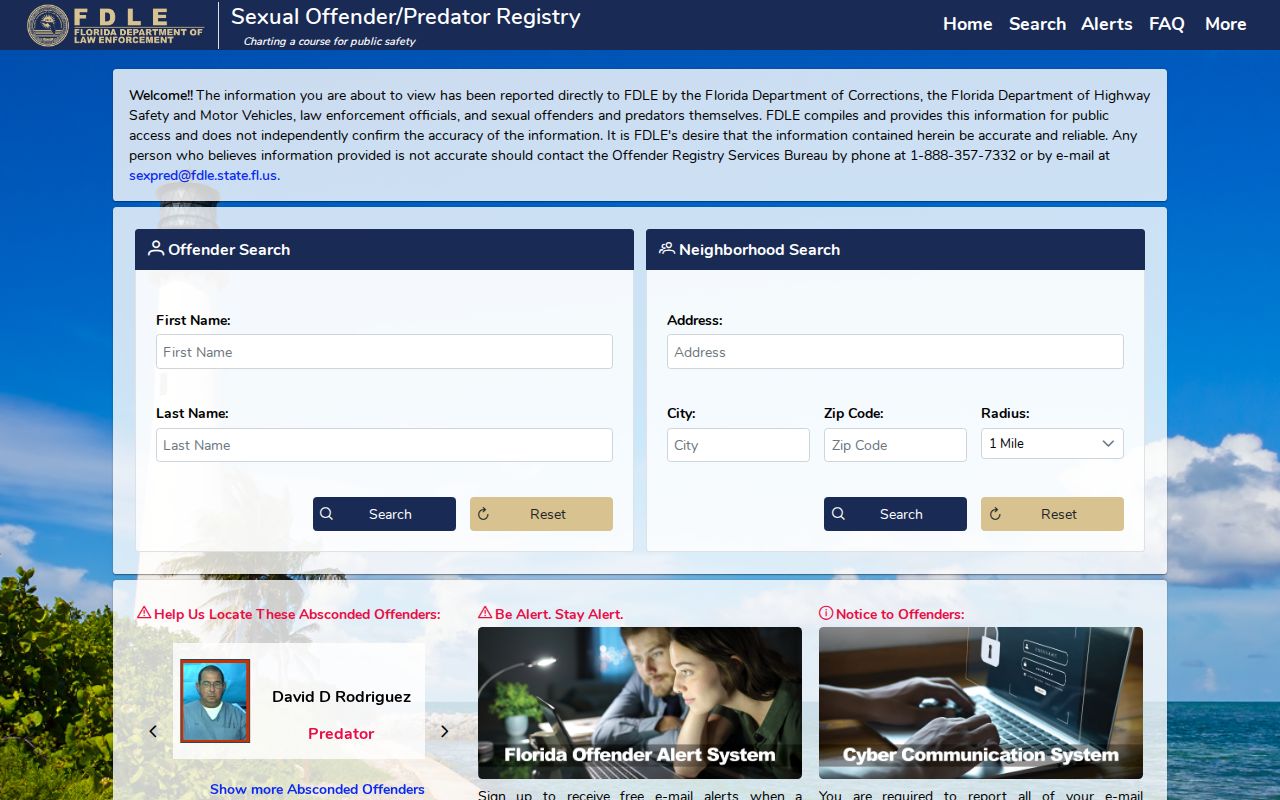
The interface gives Duval County residents a direct official starting point without relying on a third-party list.
Duval Offender Tracking Unit
Local registration takes place through the JSO Offender Tracking Unit at 1024 Superior Street, Jacksonville. The office is open weekdays from 8 a.m. to 5 p.m., excluding holidays, and can be reached at 904-630-8600, option 2. Jacksonville's schedule lists a $25 regulation fee. These details concern the registrant's local reporting duties, not a charge for the public to search FDLE records.
JSO's 2024 report gives useful scale. The unit monitored about 2,593 sexual offenders and predators plus 298 career criminals, and it performed 7,982 verifications. Those figures describe a dated workload, not the current number at any address. They also show why a profile's source date matters. For a suspected reporting problem, provide the exact address or profile detail to JSO rather than confronting anyone.
Registry Profiles: What They Show
A Duval County registry profile combines identity descriptors, reported locations, designation, status, and qualifying offense data. It can show permanent, temporary, transient, or institutional addresses, along with the source and received date. Vehicle information may also be public. The record is designed for notification and awareness. It is not a complete arrest, court, or correctional history, and the displayed offense should not be stretched into claims the profile does not make.
| Name & Aliases | Current name and reported aliases used to distinguish similar results. |
|---|---|
| Photo & Description | Photo date, birth date, race, sex, hair, eyes, height, weight, scars, marks, and tattoos. |
| Reported Address | Permanent, temporary, transient, or institutional location, plus source, received date, and map. |
| Offense & Statute | Qualifying offense, statute, jurisdiction, adjudication date, case, and victim indicators allowed by law. |
| Florida Designation | Sexual Offender, court-designated Sexual Predator, or qualifying juvenile category where public. |
| Registration Status | Released, supervised, confined, absconded, or another reported status, with DOC number when present. |
The FDLE results and profile interface connects the result list to the fuller field set.
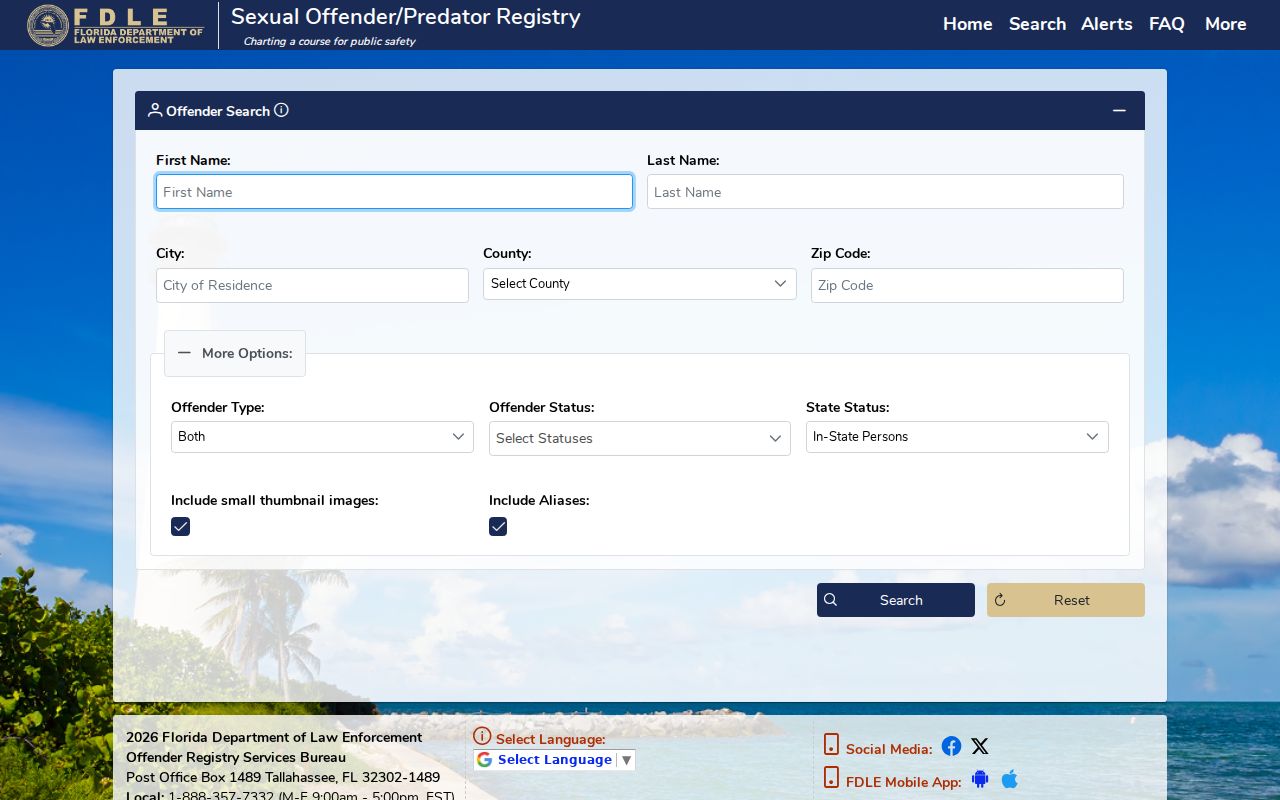
Opening the full profile, rather than relying on a list row, gives the context needed to avoid a false match.
Duval Alerts and Cross-State Checks
Florida Offender Alert lets a user track changes associated with a registry entry. It is useful when an address or status may change after the first Duval County search. An alert still should be read with the same care as the profile, including its reporting source and date.
For a search that crosses Florida's border, use the U.S. Department of Justice's National Sex Offender Public Website. NSOPW queries participating jurisdiction registries, while FDLE remains the more detailed source for Florida reporting categories and local profile fields.
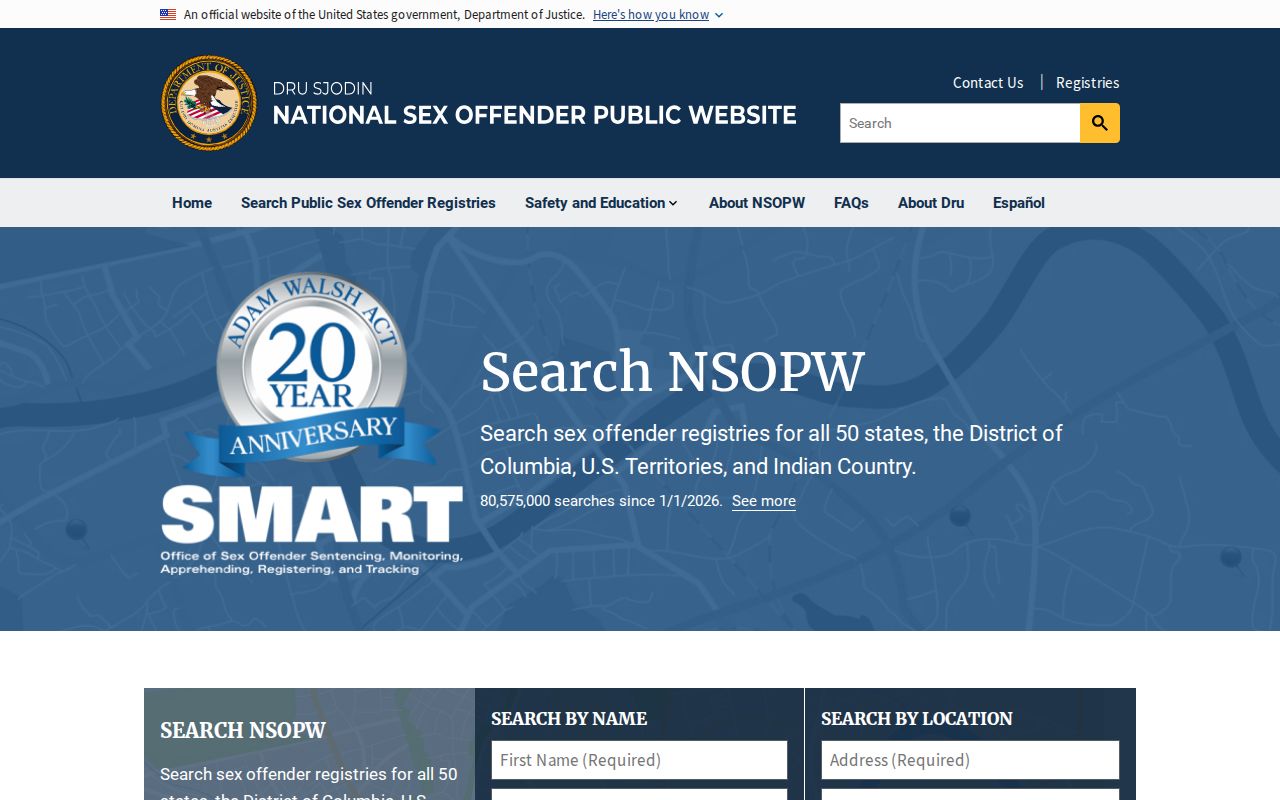
The national layer broadens geography, but a Florida result should still be checked against the current FDLE profile.
Duval Registry Address Types
A mapped point does not always mean a permanent home. Florida profiles distinguish permanent, temporary, transient, and institutional addresses. Each address may carry its own source and received date. Read that label before drawing a conclusion about where a person lives or how long the location applies.
A transient entry may describe a reporting status rather than a standard street residence. An institutional address can reflect confinement. When a Duval County location seems stale or inconsistent, save the profile details and report the concern to JSO's tracking unit. The public should not investigate at the address.
Registration Levels and Duties in Florida
Florida does not publish SORNA-style Tier I, II, and III labels for these records. Public pages instead identify statutory categories. A sexual predator designation is made by a court and carries mandatory community notification. Sexual offender status follows the applicable Florida registration law. Certain qualifying juvenile records are public only when statutory criteria are met. None of these labels should be described as an individual risk score.
| Florida Category | Duration | Reporting / Visibility |
|---|---|---|
| Sexual Offender | Generally life; narrow petition relief may apply after at least 25 qualifying arrest-free years. | Public when criteria apply; ordinarily twice yearly, or quarterly for specified offenses. |
| Court-Designated Sexual Predator | Life unless qualifying pardon or postconviction relief applies. | Public with mandatory community notification; quarterly reporting. |
| Qualifying Juvenile Sexual Offender | Generally life, subject to specific relief. | Public only under statutory criteria; quarterly reporting. |
The narrow petition route after 25 qualifying arrest-free years is not an automatic tier expiration. Eligibility depends on Florida law and the person's record. It should never be inferred from the age of a Duval County profile.
Correcting a Duval Registry Concern
If an address or status appears wrong, first record the profile URL, the field at issue, and the source or received date. Contact the JSO Offender Tracking Unit for a Duval registration concern. FDLE's registry bureau can be reached at 888-357-7332 or sexpred@fdle.state.fl.us for state-system questions. This reporting path gives the proper agency a specific fact to check.
Do not use a photo alone to declare a match. Similar names and physical traits can mislead, and FDLE states that fingerprints are needed for positive identity. A profile also does not replace the underlying court file. Readers who need the adjudication and docket can use the county's court case lookup, while keeping registry and court purposes distinct.
Using Registry Information Lawfully
Registry information supports personal, family, and neighborhood safety planning. Community notification is mandatory for court-designated sexual predators, and FDLE profiles and alerts make reported changes available to the public. Use those facts to make calm plans, verify locations, and contact the responsible agency. Never confront a listed person or treat a registry entry as permission to threaten, shame, or interfere with a household.
Misuse is unlawful: Florida Statutes section 775.21(10)(d) makes demanding payment, knowingly publishing false registry material as a public record, or materially altering it to misrepresent a first-degree misdemeanor. Never harass, threaten, or confront a registrant.
A lawful Duval County sex offender check stays close to what the official record actually says. Note dates, compare identifiers, and report suspected noncompliance to JSO or FDLE. The registry is a notification record, not proof of a new offense and not a substitute for fingerprint identification.