
Criminal Court Cases in Duval County
The Fourth Judicial Circuit Court handles Duval County felony cases. Duval County Court handles misdemeanors, criminal traffic matters, and municipal ordinance cases. Both keep their judicial files through the Duval Clerk at the county courthouse. The State Attorney may change an arrest charge before filing, decline to file it, or file counts at a different degree. That makes the clerk’s case file the sound source for the judicial outcome.
A case record is organized around a case number and docket. It can connect parties, counsel, charges, hearings, orders, financial obligations, and the final judgment. It does not replace the arresting agency’s incident narrative. Likewise, an arrest record cannot prove what the court later decided. A reader tracing a recent arrest can move from the official Duval County arrest search to CORE after the first appearance or charging documents are filed.
Search Duval CORE Three Ways
The Clerk Online Resource ePortal, known as CORE, is Duval County’s central public court index. Search by a unique case number when possible. A citation number can narrow a criminal traffic matter, while party-name fields help when no number is known. Filing dates and court type reduce false matches among common names.
| CORE field | Best use | Search note |
|---|---|---|
| Case Number | Known Duval County case | Strongest unique key |
| Citation Number | Criminal traffic case | Use the exact citation |
| Last, First, Middle Name | Party search | Try aliases and date limits |
| Filing Year or Date | Narrow results | Useful for common names |
| Case or Court Type | Separate felony and county files | Choose circuit or county criminal |
The official CORE interface shown here illustrates the county-specific search route.
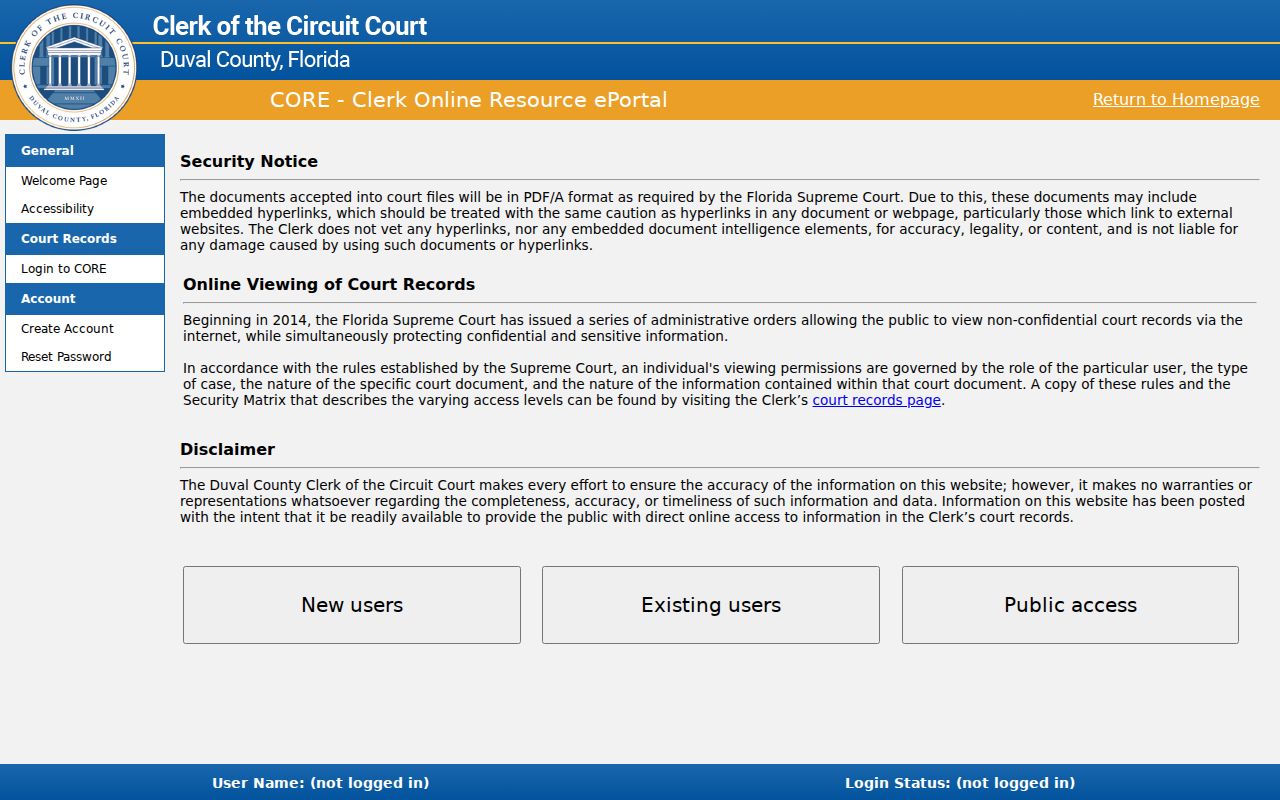
Its filters help distinguish a Fourth Judicial Circuit felony file from a County Court misdemeanor or traffic file.
Duval County Case Record Searches
Begin with CORE, but do not treat online display as the whole file. General users can see nonconfidential case information and documents already made public. Free registration lets a user ask the Clerk to review, redact, and publish an eligible document marked “View on Request.” Review time varies. Registration does not unlock confidential, sealed, or legally protected material.
- Search the exact case or citation number. If neither is known, use the full party name and narrow the filing date.
- Open the correct Duval County result and compare court type, filing date, parties, and status before relying on it.
- Read each charge and docket event, then open the linked order or judgment when available.
- Use “View on Request” for an eligible unpublished image and allow time for clerk review and redaction.
- Ask the relevant courthouse counter for immediate document help, certified copies, or a case that cannot be resolved online.
The Clerk does not perform a broad background check. A requester must identify a case or use the appropriate JSO or FDLE channel for a different record product.
Duval Felony and Misdemeanor Counters
Duval County divides in-person criminal service by court level. The felony counter is in Room 2136. The misdemeanor counter is in Room 1223. Both are at the Duval County Courthouse, 501 West Adams Street, Jacksonville, Florida 32202, and the researched weekday counter hours are 8 a.m. to 5 p.m. The Clerk’s main number is 904-255-2000. Confirm the division and current hours before travel.
Fourth Judicial Circuit Felony Counter
Room 2136
501 W. Adams St.
Jacksonville, FL 32202
904-255-2000
Duval County Court Counter
Room 1223
501 W. Adams St.
Jacksonville, FL 32202
904-255-2000
The counters can address certified copies, older-record questions, and public documents that are not ready in CORE. The State Attorney and Public Defender participate in cases, but neither office is custodian of the judicial file.
What a Criminal Case File Contains
A Duval County criminal case file shows how filed allegations moved through court. Read the case heading first, then examine each count and its separate disposition. One count may be dismissed while another ends in a plea or judgment. Docket text is an index entry, not proof of every fact described. Open the related order when public access permits.
| Case Identity | Case number, court type, filing date, status, and parties |
|---|---|
| Charges and Counts | Description, statute, degree, and count-level outcome where reported |
| Docket Events | Dated sequence, description, and public document links |
| Hearings | Date, time, type, judge, and location |
| Bond | Amount, type, and status where entered |
| Financial Record | Assessments, payments, restitution, and balance |
| Disposition and Sentence | Judgment, adjudication, sentence, and conditions |
Arrest or citation identifiers may appear, but their availability varies. Protected personal data is suppressed from public views.
Read Duval Dispositions Count by Count
Florida terms can change the meaning of a result. “Nolle prosequi” means the prosecutor stopped a charge. A dismissal is a court termination. An acquittal means the person was found not guilty at trial. A withhold of adjudication is not an adjudication of guilt, but it is not a dismissal. “Adjudicated guilty” denotes a conviction.
- Nolle prosequi
- The prosecution discontinued that charge.
- Dismissal
- The court ended the charge without a guilty judgment.
- Acquittal
- A not-guilty result after trial.
- Withhold of adjudication
- The court withheld a formal adjudication of guilt; the charge was not dismissed.
- Adjudicated guilty
- The court entered a conviction on that count.
Do not apply one label to the whole file until every count is checked. The booking charge, filed charge, amended degree, and final result may all differ.
Criminal Case Stages in Duval County
Most Duval County criminal files begin after an arrest or notice to appear. Florida’s first-appearance process addresses initial custody and release issues. Prosecutors then review the evidence and may file an information, seek an indictment, amend a charge, or decline prosecution. Arraignment records the plea. Discovery, motions, negotiation, or trial follow before judgment and sentence.
Case flow: Charges Filed → Arraignment → Pretrial → Plea or Trial → Disposition → Sentencing
An appeal or postconviction proceeding may add later entries. Hearing dates can move, and a docket notation may lag the signed order, so the filed document and current calendar deserve a final check.
Duval County Copy Fees
The current Duval Clerk fee schedule controls. Older misdemeanor forms display lower legacy search or certification figures that conflict with the current schedule. Use the live schedule and obtain a current estimate for a large request.
| Clerk service | Researched amount |
|---|---|
| Record search | $2 per year searched |
| Plain copy | $1 per page |
| Certification | $2 per document |
| Exemplification | $7 |
| Online eCertification processor | $6 plus 3.5% card fee |
The official fee-page image below reinforces why current online figures should displace an old printed form.
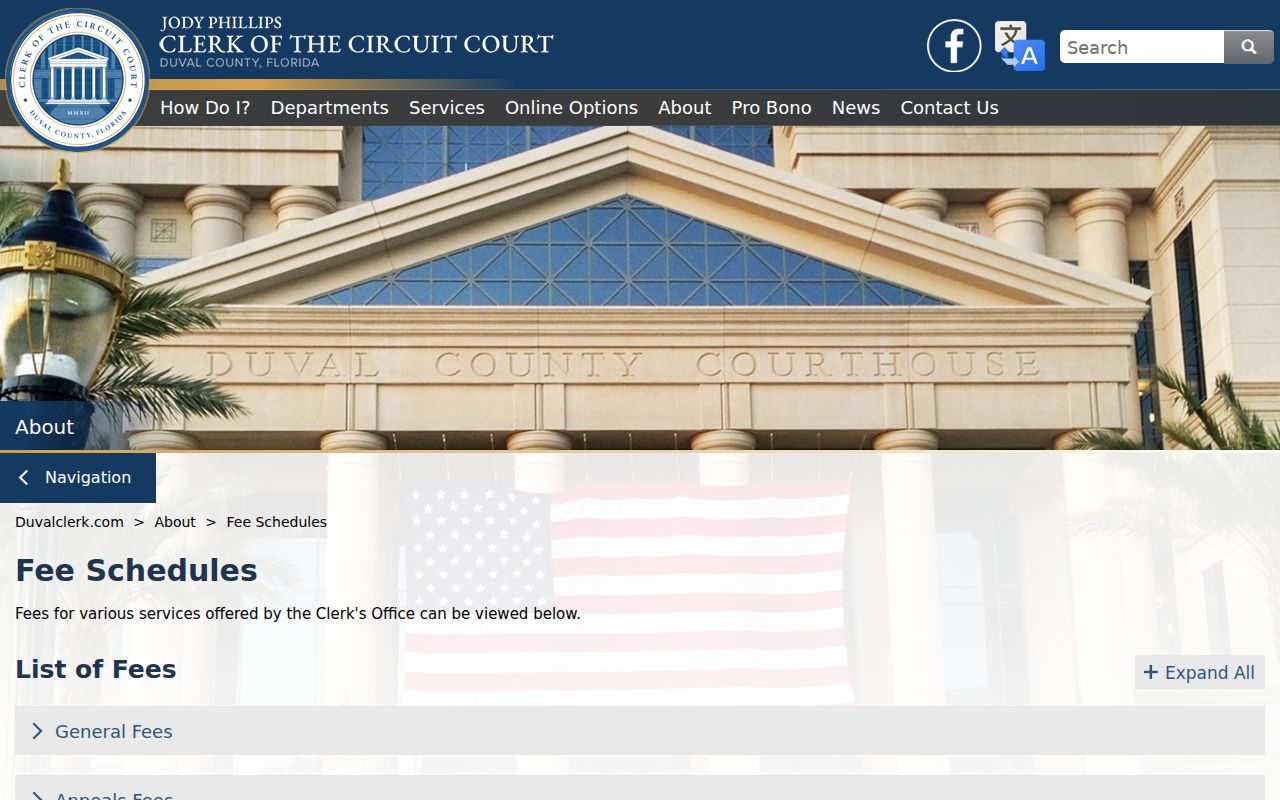
An eCertified link remains available for 30 days, and its QR code or link supports authentication and unlimited prints during that period.
Duval Drug Court Docket Clues
Duval Drug Court operates from Room 2321, with a researched contact number of 904-255-1040. The Public Defender also identifies veterans, mental health, and drug specialty work. A docket label alone does not establish eligibility, participation, or completion. Confirm those points through the current court division and signed orders.
Specialty-court entries can add referrals, reviews, treatment conditions, sanctions, and graduation or termination events to the docket. These entries should be read in sequence with the plea and sentencing documents. They do not change the basic rule that the Clerk holds the court file while a treatment provider’s confidential records remain outside ordinary public access.
Access Rules for Case Records
Florida law favors access to public court records, but access is not unlimited. Sealed matters, confidential juvenile records, protected victim details, Social Security numbers, medical information, and active investigative material may be hidden or redacted. A public CORE index entry may remain while its document image is unavailable. “View on Request” means review is possible, not guaranteed release.
Florida Public Records Law governs agency records, while court records also follow judicial access rules and sealing orders. Ask the Clerk for the legal basis when access is restricted.
If CORE cannot supply a document, use the correct criminal counter, provide the case number, and state whether a plain or certified copy is needed. A federal charge belongs in PACER and the Middle District of Florida, not necessarily in Duval County CORE.
Note: A missing online image does not prove a missing case; it may await review, redaction, scanning, or lawful restriction.