
Jacksonville Beach Criminal History Checks
A useful search begins by naming the record, its likely custodian, and the event location. Jacksonville Beach Police Department, or JBPD, can supply a report it created and can run its limited local-history product. It cannot turn that request into a Duval-wide or Florida-wide history. A report, booking entry, court docket, and FDLE repository result answer different questions. Search them in the order that fits the event rather than treating a blank result as proof that nothing exists.
- Ask JBPD Records for its police report or Jacksonville Beach-only local-history search.
- Give the case number, incident date and time, subject details, or address that can narrow the request.
- After a custodial arrest, use JSO Inmate Search for current Duval booking and custody information.
- Use Duval CORE or the Beaches Branch for filed charges, docket events, and the final disposition.
- Use FDLE for reported statewide Florida history or fingerprint Personal Review for your own identity-supported record.
This sequence also helps with corrections. If the police narrative is wrong, contact JBPD. If the docket is wrong, work with the Duval Clerk. An identity or repository problem belongs with FDLE and may require fingerprints.
Jacksonville Beach Records at Penman Road
JBPD Records works from 101 Penman Road South, Jacksonville Beach, Florida 32250. The desk lists 904-270-1667, fax 904-270-1660, and policerecords@jaxbchfl.net. Its weekday hours are 8 a.m. to 4:30 p.m. A requester may use the counter, mail, email, or fax. That range is useful when an online search cannot show a narrative, audio, photo, or locally maintained history.
The department asks for prepayment before printing or redaction work. Its current page says processing may take up to seven business days. A printed form uses seven-to-ten-business-day language, so a requester should treat the live estimate from the records staff as controlling. Broad video or heavily redacted requests can take longer than a basic report copy. A clear date range, location, and case number can reduce search time.
The official Jacksonville Beach Records page shows the city route and current desk information.
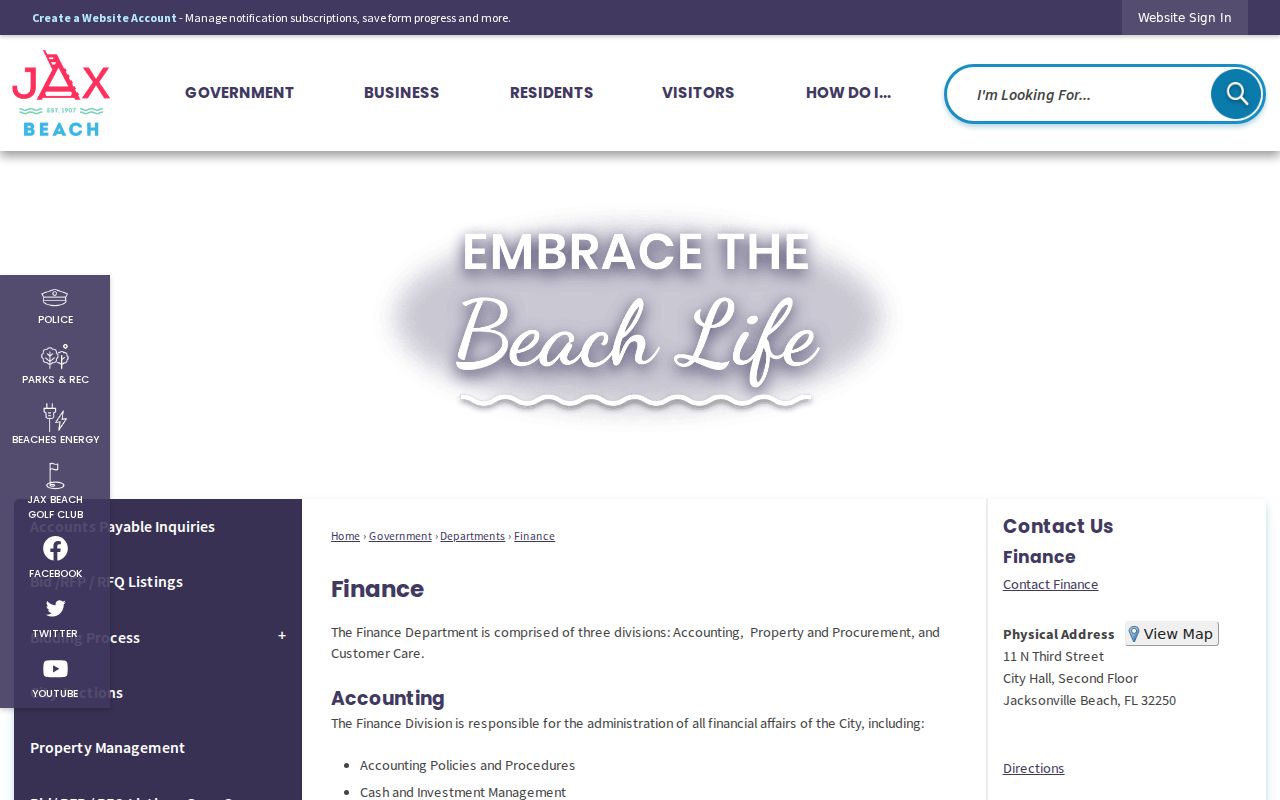
The city page is the right checkpoint before relying on an older printed form, especially for timing, payment, and contact changes.
Records at Jacksonville Beach Police
JBPD owns reports created by its officers inside the city. Those may include incident narratives, crash material, local arrest reports, photos, or dispatch-related media when releasable. The subject of a request should not be confused with the requester. The department may need enough detail to locate the file and then review it for information protected by Florida law.
A nonemergency event that needs to be reported uses Communications at 904-270-1661, not the records desk. The filing route asks callers to have the location, date and time, event summary, possible suspect facts if known, and a description of stolen property. Once a report exists, Records becomes the custodian for copies. Emergencies still go through 911.
Agency identity is crucial along the beach. A report made by Atlantic Beach, Neptune Beach, JSO, FHP, a campus agency, or a federal officer does not become a JBPD report merely because someone later visits Jacksonville Beach. Check the badge, citation heading, report prefix, or court caption before sending a request.
Jacksonville Beach Report Form Fields
The JBPD request form provides a practical checklist even when the request is sent by email. It includes requester and delivery details, then facts used to distinguish the person or event. Supplying a known case number is best. A date, time, address, and date of birth can help when no number is available.
| Requester details | Company if applicable, mailing address, phone, requester name, and email |
|---|---|
| Subject details | Last, first, and middle name, address, and date of birth |
| Incident details | Incident date, time, and the Jacksonville Beach case number |
| Delivery and billing | Contact information used for estimates, prepayment, and the requested copy format |
Florida public-record law does not require a requester to explain why a public record is wanted. Still, enough descriptive detail is needed to identify the item. The city may redact exempt facts, and extra review can affect cost and delivery time.
Booking and Arrest Records in Jacksonville Beach
JBPD may make the arrest, but Jacksonville Beach does not run a separate public county-jail database. A custodial arrest enters JSO's Duval detention system. That split creates two records: JBPD retains the police narrative and probable-cause material it created, while JSO maintains booking and current custody data. The two can appear at different times and use different identifiers.
Use JSO Inmate Search after transport. When spelling, intake timing, or a recent release makes the result hard to find, the research lists 904-630-5760 as the custody phone route. A booking result is not the final charge or outcome. Once prosecutors file a case, CORE supplies the judicial trail. The county-wide Duval arrest search explains that booking layer in more depth.
An arrest states an accusation and custody event. It does not prove guilt. Read the later court disposition count by count because a filed charge can differ from intake language, and a case may end in dismissal, nolle prosequi, plea, trial, or another result.
Jacksonville Beach Local Check Fees
The $5 local-history search is narrow by design. It checks Jacksonville Beach records only. It does not cover JSO events elsewhere in Duval County, the other beach police departments, every Florida court, federal cases, or FDLE's statewide repository. That boundary should be stated when the result is used for self-review or to resolve a known local event.
| Product | Published detail |
|---|---|
| Local history | $5, Jacksonville Beach records only |
| Paper copies | 15 cents single-sided or 20 cents double-sided |
| Photograph | $1 for a color photo |
| 911 audio | $2.15 on the published form |
| Video disc | $3.86 on the printed form |
Payment may be made by cash, check, or money order under the form terms. Redaction or extensive work can add charges, and prepayment applies. Ask the desk for a current estimate before authorizing a broad media request.
The Jacksonville Beach Municipal Court File
Jacksonville Beach has no separate municipal criminal court. Florida's state court structure places local criminal traffic, ordinance, misdemeanor, and felony records with Duval courts and the Clerk. The Duval Clerk Beaches Branch at 1543 Atlantic Boulevard in Neptune Beach is the useful local counter. It operates weekdays from 8 a.m. to 4:30 p.m., but it remains part of the county Clerk rather than a Jacksonville Beach tribunal.
| Court name | Duval County and Circuit Courts, served locally through the Clerk's Beaches Branch |
|---|---|
| Case types heard | Criminal traffic, ordinance matters, misdemeanors, and felonies within the proper county or circuit division |
| Case lookup channel | Duval CORE online or the Beaches Branch clerk counter |
| What the docket shows | Case number, parties, charges, filings, hearings, dispositions, and sentencing entries when public |
| Copies and fees | Clerk copies and certified records follow the Duval Clerk's current fee schedule |
JBPD may handle animal or parking citations through local administrative routes, while criminal traffic goes to the Clerk. Read the issuing document. The official city municipal court information route explains where local matters are directed.
The routing page prevents a common error: looking for a city criminal docket that Florida's court system does not maintain.
Jacksonville Beach CAPE Record Context
The Community Assisted Policing Effort, called CAPE, gives Jacksonville Beach a current and distinctly local public-safety context. Fiscal year 2025 CRA funding supported a dedicated downtown officer for proactive patrol, nuisance response, business contact, and Crime Prevention Through Environmental Design. CPTED means shaping lighting, sight lines, access, and property use to reduce opportunities for harm.
The Downtown Community Redevelopment Area covers 185 acres from 13th Avenue South to 9th Avenue North and from Third Street to the ocean. That geography can help identify whether a city program or JBPD record is relevant. It does not prove that an address is unsafe or that a person has a criminal record. CAPE is a city program, not a separate database.
Beach access, events, parking, nightlife, seasonal visitors, and downtown business activity shape the kinds of calls JBPD handles. Current official city crime tables were not found in the PD archive, which appeared to stop at 2018. Avoid using stale totals as a present-day claim. A dated FDLE or FBI agency table is the sounder source when current statistics are needed.
How Jacksonville Beach Records Reach Duval
A city event can create several linked files without placing all of them in one office. JBPD keeps the report. JSO records intake and custody after a custodial arrest. The Duval Clerk maintains the filed case and disposition. FDLE receives reported criminal-history events through Florida's repository process. Each custodian can correct only its own part.
Record flow: Jacksonville Beach Police Department › Duval County Courts › Florida Department of Law Enforcement
For a recent incident, begin close to the source. For a final outcome, move to CORE. For statewide self-review, FDLE offers fingerprint-based Personal Review. A name-based FDLE search is a separate paid product and can miss or confuse identities, so compare identifiers and verify the originating record.
Jacksonville Beach Older Crash Records
Traffic crash custody changes with age. Jacksonville Beach routes crash reports older than two years to the Florida Department of Highway Safety and Motor Vehicles. A city request for one of those records may therefore produce directions rather than the report itself. That is not a false negative. It means the record has moved to the state channel.
Start with JBPD when the crash is recent and occurred within city limits. Give the crash date, location, parties, and report number if known. If staff directs the request to FLHSMV, follow the state process and its current identity or fee rules. A citation resulting from the crash is different again: its court trail belongs with the Duval Clerk.
Jacksonville Beach Record Access Rules
Florida's Constitution and Public Records Act begin with broad access, but they do not make every line of a police or court file public. Active criminal intelligence or investigative information may be withheld while it remains active. Juvenile, victim, medical, identifying, sealed, and expunged material can also be restricted under the law that applies to that record. JBPD and the Clerk must review their own files before release.
Key Statutes:
Florida Statutes Chapter 119 sets the public-record request and access framework.
Florida Statutes §119.071 lists exemptions that include protected law-enforcement information.
Florida Statutes §943.053 governs dissemination of criminal-history information by FDLE.
Florida Statutes §943.0585 governs court-ordered expunction and limits access after relief.
Ask for segregable public portions when a full file cannot be released. A denial or redaction should identify the legal basis. Sealing or expunction does not mean every private copy vanished, but it changes official access and must be honored by the agencies covered by the order.
When Jacksonville Beach Records Look Blank
A blank city result often reflects scope, timing, or custody. Confirm that the event occurred within Jacksonville Beach, not another beach municipality or consolidated Jacksonville. Check whether the person was booked under a different spelling. Then look for a Duval case using the citation or case number rather than relying only on a party name.
If the event is recent, call the correct custodian before assuming no record exists. If it is old, ask whether the crash, case, or repository entry moved to another system. For an identity mismatch in your own criminal history, FDLE Personal Review provides the fingerprint-supported route. These checks are more reliable than repeating the same name query in one database.