
Jacksonville Criminal History Checks
Begin a Jacksonville record check with the event, not a broad name query. A police report number points to JSO Public Records. A jail number or very recent arrest points to JSO Inmate Search. A case number points to CORE. If none is known, collect the exact name, date range, incident place, and agency shown on any citation or paperwork.
- Identify the Jacksonville agency and record type from the report, citation, booking entry, or case paper.
- Request the JSO report online, by phone, mail, headquarters counter, or a district counter.
- Check current custody through JSO Inmate Search and call inmate information when spelling or intake timing causes doubt.
- Search CORE for filed charges, docket events, disposition, sentence, and court documents available to the public.
- Use FDLE for reported statewide Florida history or its free fingerprint Personal Review for one's own record.
These channels overlap without being interchangeable. A Jacksonville arrest charge can change before prosecutors file a case. A booking result may disappear from a current-custody search while the court docket remains. FDLE's name product reaches beyond Duval County, but only fingerprints establish positive identity.
Jacksonville's Consolidated Police Agency
Jacksonville does not have a separate city police department beside the county sheriff. Consolidation made the Jacksonville Sheriff's Office both the sheriff's office and Jacksonville's police agency. That structure explains why JSO holds city incident reports, operates corrections intake, and supplies arrest data to other parts of the Duval justice system.
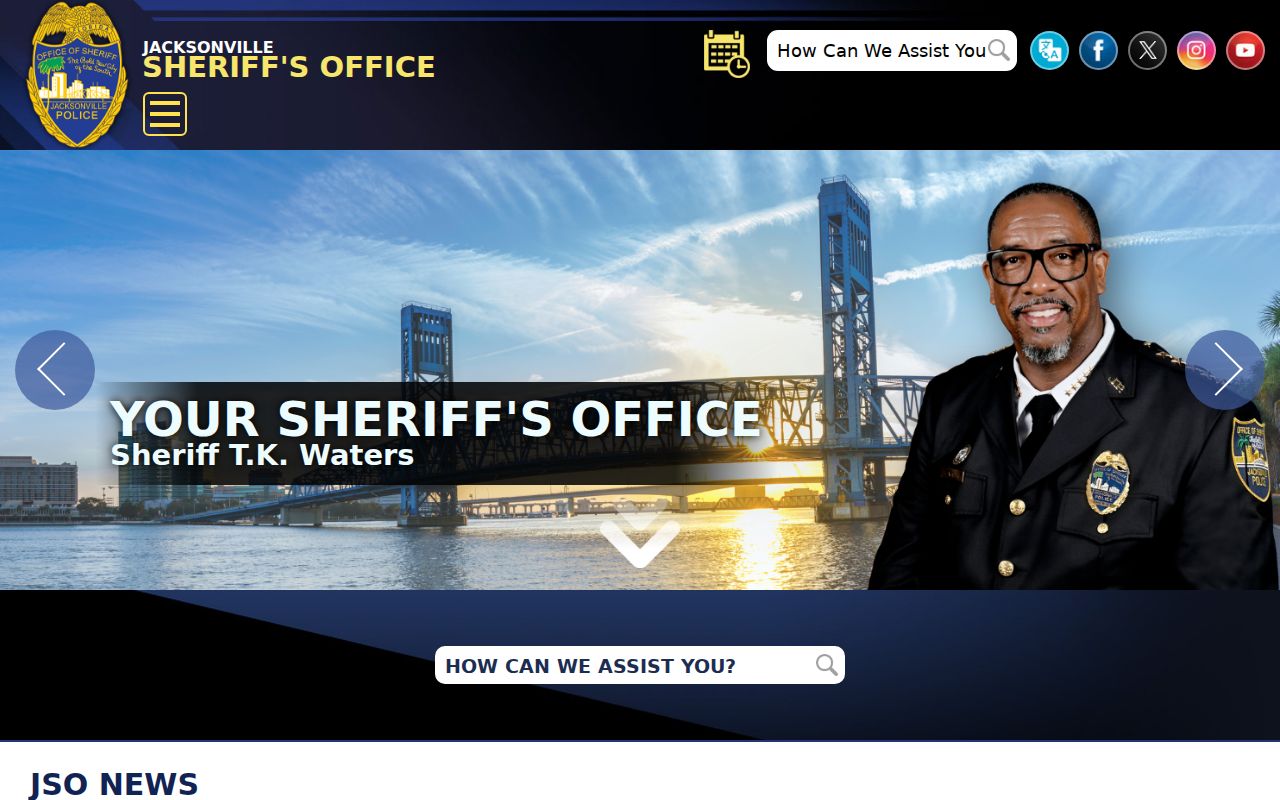
The official JSO home page is the stable starting point for agency services, even when a deeper service page changes location.
Consolidation does not mean every event within Jacksonville belongs to JSO. Jacksonville's river, port, airport, campuses, coast, and interstate corridors place specialized agencies in the same geography. An airport incident may involve Jacksonville Aviation Authority Police, a University of North Florida event may involve campus police, and an interstate crash may involve the Florida Highway Patrol. The agency name on the source document determines where the report request should go.
Records at Jacksonville's Sheriff
JSO's Public Records Unit is at 501 East Bay Street, Jacksonville, and can be reached at 904-630-2209. Requests may be sent through the online MyCustHelp/JustFOIA route, by telephone, by mail, at headquarters, or through district counters. The portal supports submission and tracking, but its conditional fields are dynamic. Confirm the current prompts rather than assuming which fields are mandatory.
A focused request should give the incident or report number when known, the incident date or range, the Jacksonville address or intersection, the requested record type, and the desired delivery format. Helpful detail may include the involved unit or person description and whether the request seeks a report, CAD record, audio, video, booking material, or correspondence. Florida law does not require a requester to explain why the record is wanted.
Ordinary copies are listed at 15 cents for one-sided pages and 20 cents for two-sided pages, with certification at $1. Work requiring extensive review or redaction receives an estimate. Ask for that estimate before authorizing a broad video or correspondence search. JSO notes that contact information submitted with a request may itself become a public record, so a person concerned about exposing an email address can use telephone or written correspondence.
Jacksonville District Record Counters
Six district counters provide alternatives to the downtown Jacksonville headquarters. That access matters across a city covering 747.29 square miles. A short, focused request may be handled while the requester waits, while work beyond roughly 30 minutes is estimated. Counter service does not change which office owns the record, and general building hours do not expand the Public Records Unit's weekday telephone schedule.
Before visiting, call 904-630-2209 to confirm the proper counter and current service conditions. Bring the same facts needed online: event number, exact date or range, place, and the product sought. A district counter can route a JSO report request. It cannot turn an incident file into the later court disposition.
Jacksonville MyCustHelp Record Portal
The online JSO request route uses a MyCustHelp/JustFOIA system to accept and track Jacksonville public-record requests. Because its questions change with the chosen product, the research did not support a fixed required-field list. Select the record type in the live portal and answer the prompts it actually displays.
Good source facts still make the process faster. Supply an event number, date or narrow range, address or intersection, and a clear description of the report, audio, video, CAD data, booking material, or correspondence requested. Keep the confirmation number so the request can be tracked. If review looks extensive, ask JSO for a cost estimate before approving the work.
Booking and Arrest Records in Jacksonville
A Jacksonville arrest normally creates at least two local records. The arresting agency creates an incident or arrest report, and JSO corrections creates the booking and custody entry. Search JSO's current-inmate interface by name or jail number. If a very recent intake or spelling problem prevents a match, call inmate information at 904-630-5760. Absence from a current system does not prove there was no arrest.
The court trail may start at first appearance before the State Attorney decides the final filed counts. Search CORE after checking custody. Once an information or indictment appears, read each count and its disposition instead of carrying forward the intake wording. The jail can address current custody and bond reception, while the clerk addresses docket entries, copies, and outcomes. After transfer to state prison, custody lookup moves to Florida Department of Corrections Offender Search.
Jacksonville Records Can Split
A record can involve several Jacksonville custodians at once. JSO may book a person arrested by another agency. The State Attorney may file counts that differ from the agency's intake charges. The clerk then maintains the judicial case. A federal defendant can appear in PACER while housed locally, adding a federal court file to the local custody entry.
Use a simple test when a search fails: look for the badge or agency on the citation, the report-number prefix, the booking entry's arresting agency, or the court docket's case type. Request the originating report there. Then use CORE for the Duval judicial outcome. This approach is far more precise than asking one office for every Jacksonville record tied to a name.
The Jacksonville Municipal Court File
Jacksonville has no separate municipal criminal court. Duval County Court and the Fourth Judicial Circuit handle local criminal cases at 501 West Adams Street, and the clerk's CORE portal is the main online route. County Court includes misdemeanors, ordinance matters, and county-level criminal traffic cases. Circuit Court handles felonies. Calling either one “Jacksonville Municipal Court” can send a requester to an office that does not exist.
| Court Names | Duval County Court and the Fourth Judicial Circuit Court, Duval County. |
|---|---|
| Case Types | County Court handles misdemeanors, ordinance matters, and criminal traffic; Circuit Court handles felonies. |
| Lookup Channel | CORE by case number or party criteria, plus the clerk's criminal counters. |
| Docket Contents | Case number, division, status, parties, charges, events, hearings, documents, judgment, sentence, and money owed. |
| Access Limits | Sealed and confidential material, protected identifiers, and restricted images are not publicly available. |
CORE may offer “View on Request” to a free registered account for documents that require review. That label is not a finding that the file is secret. It signals an access check. The clerk also states that it does not perform a general background check, so search a known name or case and evaluate each plausible match.
Jacksonville Versus Florida Record Checks
JSO and CORE provide the deepest Jacksonville detail. JSO reports describe the local event and response. The jail interface covers current custody. CORE shows the judicial course and outcome. FDLE's $24 public name search instead compiles reported Florida history across counties. Its Instant Search adds a $1 credit-card processing fee and produces an immediate noncertified result; staff-assisted certified and noncertified searches use different processing routes.
For one's own Florida record, FDLE Personal Review is free and fingerprint based. It supports correction or challenge when an arrest cycle lacks a disposition or contains an error. Name-based results should not be treated as fingerprint identity. A fuller county-level explanation of these systems is available in the Duval County criminal-history overview.
How Jacksonville Records Reach the County
Once JSO makes a Jacksonville arrest, corrections creates the booking record and law enforcement transmits identifying and charge data through Florida criminal-justice systems. The State Attorney decides what to file. The clerk opens the court case and records hearings, documents, dispositions, sentences, and financial obligations. Florida law then requires clerks and criminal-justice agencies to report dispositions so FDLE can complete the state arrest cycle.
Record flow: Jacksonville Sheriff's Office › Duval County Courts › Florida Department of Law Enforcement
Timing explains many apparent conflicts. The booking record reflects the intake charge. CORE may later show no filing, dismissal, acquittal, withheld adjudication, or conviction. FDLE depends on the reported arrest and disposition. Cite the system and date whenever saving a Jacksonville result because each custodian updates on its own schedule.
Jacksonville's Large Records Geography
Jacksonville's July 1, 2024 Census estimate was 1,009,833. Its broad geography and consolidated government make its records system unlike the smaller beach cities. JSO's 2024 annual report says more than 27,300 people moved through a 13-story, 629,000-square-foot pretrial facility with an average population near 2,400. Those figures describe operations during a stated year. They do not say whether any named person has a record.
The same annual report recorded 3,202 burglaries in 2024 and described OneCOP, Sheriff's Watch Apartments, Teen Police Academy, Teen Driver Challenge, and specialized units. Crime tables must retain their year and JSO definitions. Program participation does not make a person's identity or file public. Individual records still belong to the lawful custodian.
Jacksonville Records After State Transfer
A Jacksonville case can leave local custody channels after sentencing. Florida Department of Corrections Offender Search becomes the official locator for state prison or community-supervision status. Parole authority is separate from JSO and the Duval clerk, and Florida Commission on Offender Review handles the limited parole decisions that remain under Florida law.
The Florida Commission on Offender Review identifies the state authority responsible for those parole matters.
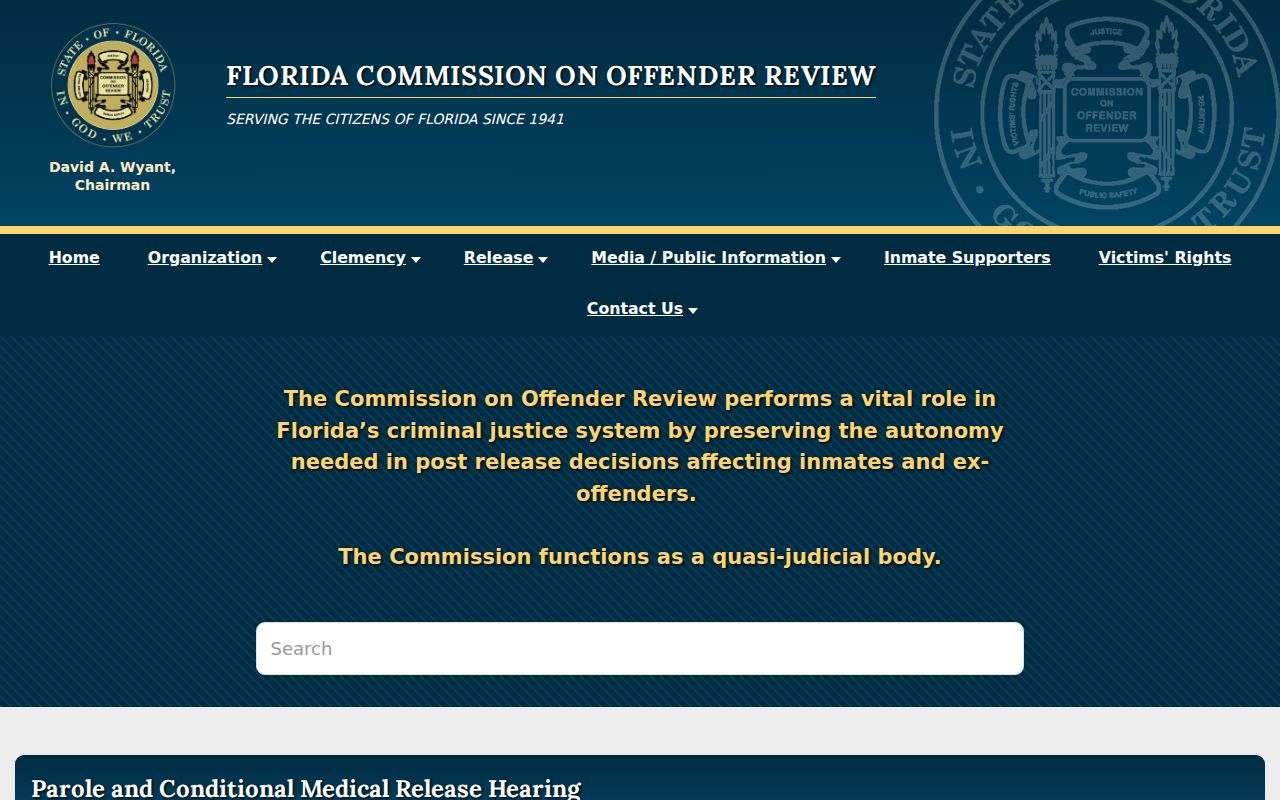
This statewide page is a routing point after a Jacksonville record has moved beyond local court and jail custody, not a substitute for the JSO report or CORE docket.
Jacksonville Record Access Rules
Florida's constitutional access right and Chapter 119 generally permit inspection of nonexempt Jacksonville and Duval records. The custodian may redact only under legal authority. A request cannot force JSO or the clerk to create an explanation, and active-investigation material, protected victim data, juvenile information, sealed records, and expunged records may be withheld. Court access also follows Florida's judicial record rules.
Key access authorities:
Florida Public Records Law, Chapter 119 permits inspection of nonexempt state and local records.
Florida Statutes section 943.053 governs FDLE dissemination and authorizes public criminal-history requests and fees.
Florida Statutes section 943.056 gives a person the right to review and challenge their own repository record.
Ask JSO for a JSO report, the clerk for the judicial file, and FDLE for repository history. That division respects Jacksonville's actual records system and gives each question to the office able to answer it.