
Arrest Records in Duval County
An arrest produces several related records. The officer’s agency creates the incident and arrest report. JSO corrections creates a jail number, fingerprints, property inventory, custody entry, booking data, and intake charge. A first appearance creates a court event, and the Clerk opens a judicial file when material is filed. FDLE receives the fingerprint arrest cycle and later disposition reports.
JSO serves both as Duval County sheriff and Jacksonville police agency, but it is not the author of every report. Jacksonville Beach, Atlantic Beach, Neptune Beach, UNF, airport, school, highway patrol, state, and federal officers retain their own investigative records. JSO may still hold the booking record when one of those agencies brings an adult to county custody.
Search JSO Jail Before CORE
The official JSO Inmate Information Search is the most direct first check for a recent county booking. It supports name and jail-number searches without an advertised fee or login. A result may show the jail number, displayed name, age, sex, race, booking date, custody or release status, facility, arresting agency, charge, bond, and a court reference.
The official inmate-search image below shows the public route without republishing any arrestee’s name or photograph.
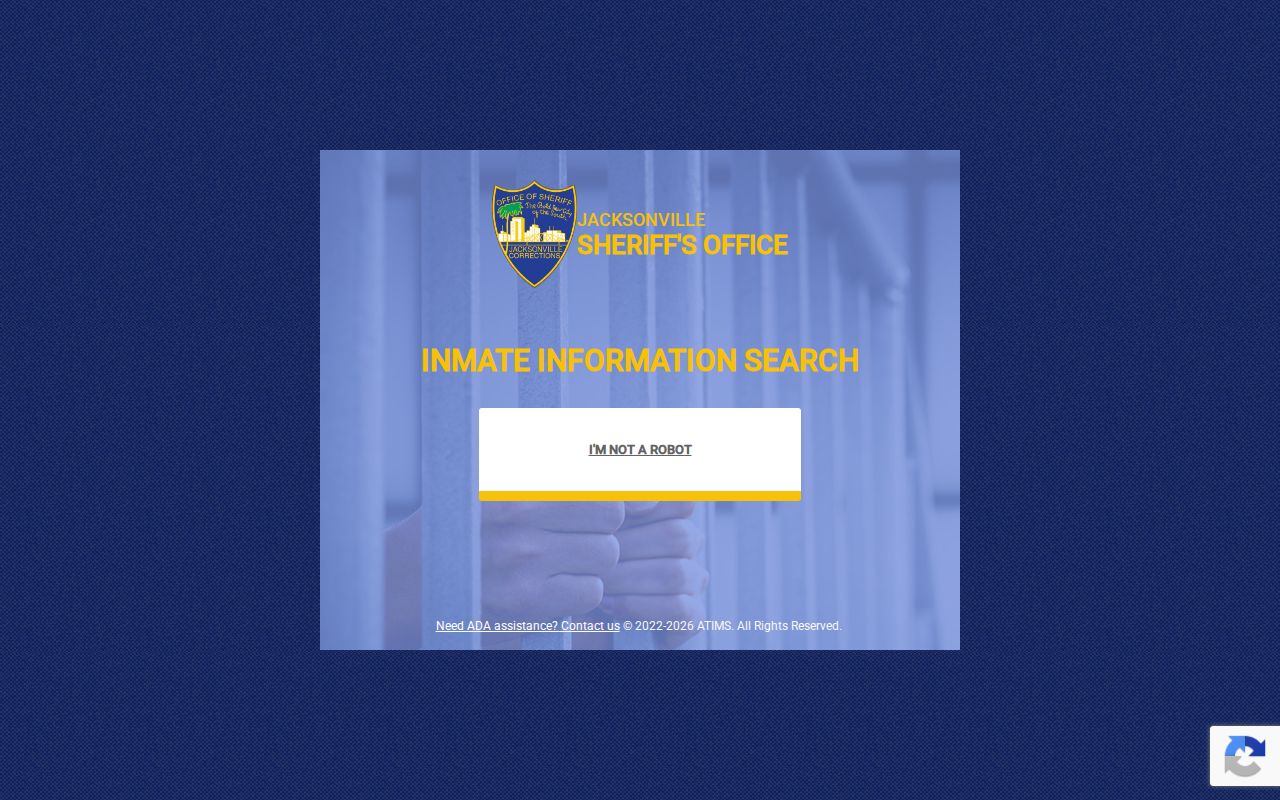
The roster is a custody tool, not a full lifetime arrest history. It does not supply the officer’s narrative or the court’s final disposition.
Duval County Arrest Lookups
No single channel answers every arrest question. Use the source that owns the stage you need, and compare identifiers before treating two entries as the same event.
- Search JSO Inmate Information by exact name or jail number for current or recent custody.
- Call 904-630-5760 if intake delay, release, or spelling may explain a missing recent booking.
- Request the arrest or incident report from the agency that made the arrest, using its report number, date, location, and record type.
- Search Duval County court cases in CORE after first appearance or filing to find the filed charge and outcome.
- Use the FDLE State of Florida Criminal History Record Check for broader reported Florida history, or request FDLE’s free fingerprint personal review for your own repository record.
FDLE’s public name search costs $24, and Instant Search adds a $1 card processing fee. A name match is not fingerprint identification. The subject-only personal review uses fingerprints taken by a law-enforcement or criminal-justice agency and carries no FDLE fee.
Missing Duval Booking: Call First
A person may not appear because the booking is still being entered, the person has been released, the name is spelled differently, or the person was not brought into JSO custody. Call the John E. Goode Pretrial Detention Facility inmate-information line at 904-630-5760 before assuming the absence has legal meaning.
If custody staff confirms no match, return to the arresting agency. Ask for the incident or arrest report, not an answer to a broad question. Supply the date range, location, report or event number, and agency. Later, CORE can show whether prosecutors filed a Duval County case. Absence from the current jail search proves neither that no arrest occurred nor that a past arrest was cleared.
Arrest Records: What They Contain
A full Duval County arrest or booking report can contain far more than the public jail result. Some fields are restricted or redacted. The existence of a field in an agency system does not guarantee that the public receives it.
| Booking Identity | Jail number, booking date and time, JSO and OBTS identifiers |
|---|---|
| Arrest Details | Agency, date, time, location, basis, method, and incident number |
| Person Description | Name, aliases, age or DOB, physical traits, and marks where public |
| Charges | Description, statute, degree, UCR or citation, and intake route |
| Custody and Bond | Facility, status, bond amount, type, and release data where entered |
| Report Material | Personnel, property, evidence, vehicle, testing, and narrative fields |
| Protected Fields | Juvenile, victim, medical, personal, and active-investigation details may be withheld |
A public result may omit granular housing, exact birth date, or a booking image. Do not infer that a field is public merely because it exists inside the corrections record.
Which Duval Agency Holds It?
The arrest report stays with its creator even when JSO handles booking. This two-custodian split is common after arrests by beach police, campus officers, airport police, or Florida Highway Patrol.
| Arresting agency | Official report route |
|---|---|
| JSO | 501 E. Bay St.; Public Records 904-630-2209; online request route |
| Jacksonville Beach Police | 101 Penman Rd. S.; 904-270-1667; policerecords@jaxbchfl.net |
| Atlantic Beach Police | 850 Seminole Rd.; 904-247-5859 ext. 5867 |
| Neptune Beach Police | 200 Lemon St.; 904-270-2410 |
| UNF Police | 1 UNF Dr., Building 41; 904-620-2800 |
| Jacksonville Aviation Authority | JAA public-record custodian |
| FHP | FLHSMV traffic-crash channel when applicable |
DCPS Police and other state or federal agencies use their own public-record or FOIA channels. JSO custody data remains separate if the person was booked locally.
Recent Duval County Bookings
Recent booking information changes as intake, bond, court action, transfer, and release are processed. The John E. Goode Pretrial Detention Facility handled more than 27,300 people in 2024 and had an average daily population near 2,400. Those figures describe correctional processing and average custody, not convictions or unique annual defendants.
The 13-story, 629,000-square-foot facility at 500 East Adams Street holds pretrial detainees and some people in other custody categories. JSO also operates the Community Transition Center and Montgomery Correctional Center. The official corrections facility source pictured here helps identify which contact fits a custody question.
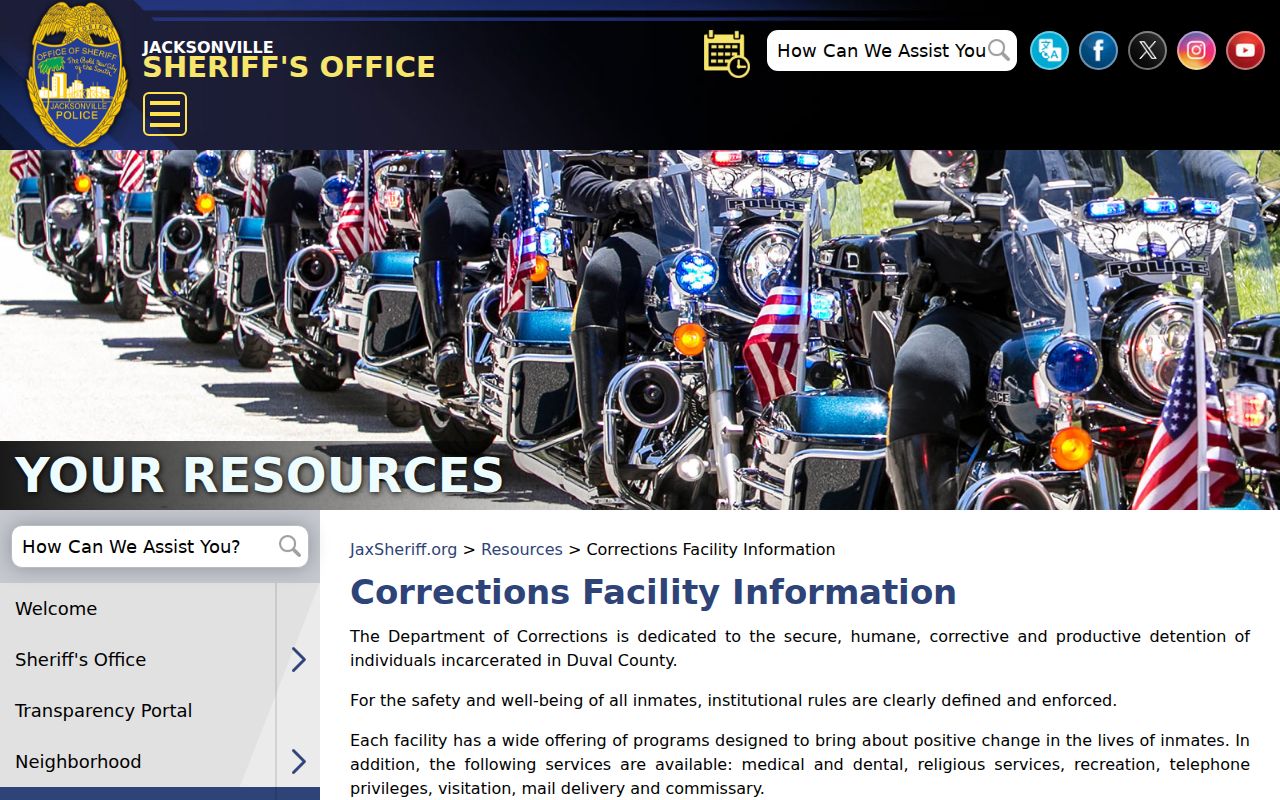
Facility operations and public-record fulfillment are different functions. Call the listed facility for custody questions and use records staff for reports or historical booking material.
JSO Arrest Report Requests
The JSO public-records route is the fallback for arrest reports, booking material not exposed in inmate search, calls for service, CAD, and other nonexempt agency records. Florida Chapter 119 does not require a requester to explain a purpose. A narrow description often produces a faster, more accurate response.
Available channels include the listed electronic route, JSO Public Records at 904-630-2209, telephone routing at 904-630-0500, and mail or in-person delivery. Ordinary copies may cost 15 cents per single-sided page or 20 cents per double-sided page, plus $1 certification and a justified search or redaction charge. Walk-in work over 30 minutes receives an estimate and prepayment requirement.
The official request-page image below marks the proper alternative when the inmate interface lacks the needed arrest record.
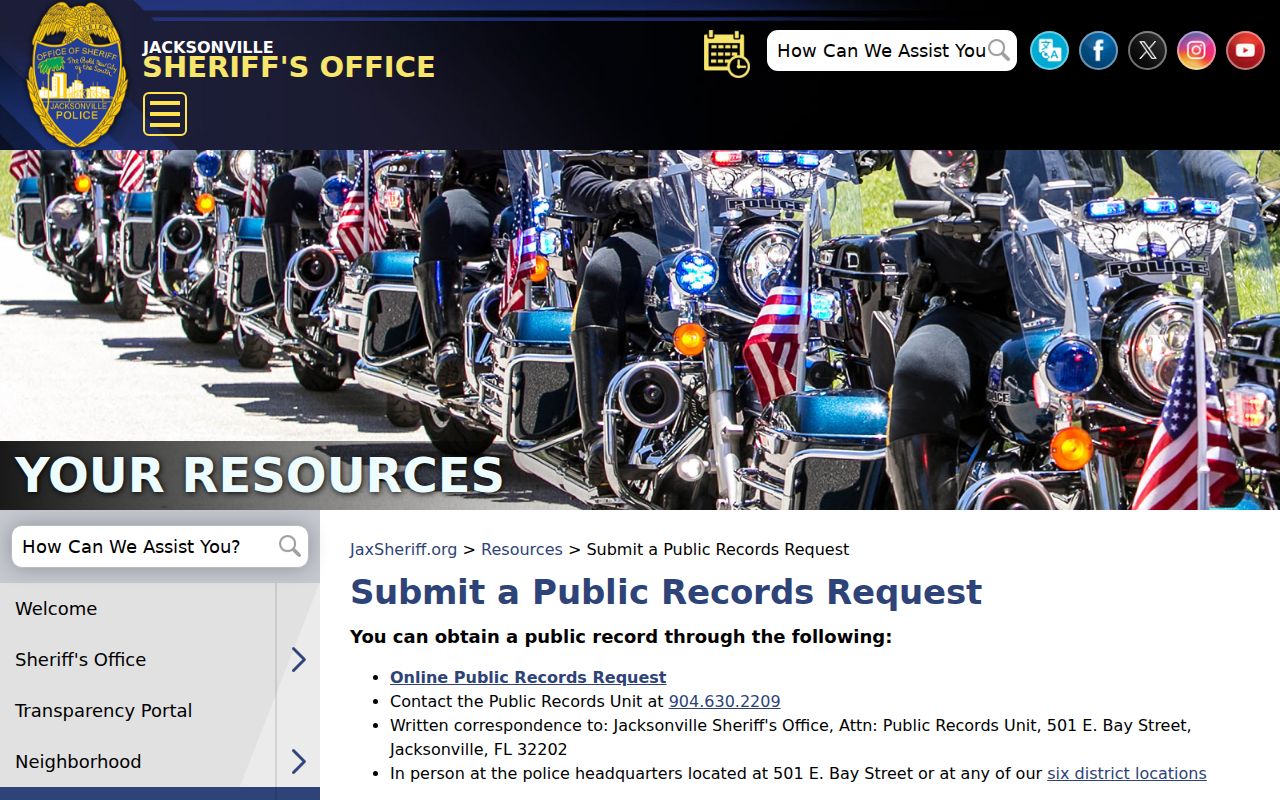
Ask for a written estimate before authorizing a broad video, email, audio, or heavily redacted search.
From Fingerprints to FDLE
Booking fingerprints and charge data move through Florida criminal-justice systems to FDLE. Later, the clerk and other justice agencies report dispositions under Florida law so FDLE can complete the arrest cycle. Timing gaps, wrong identifiers, or incomplete reporting can leave a statewide record without its final outcome.
A dismissed Duval County charge can still leave a fingerprint arrest cycle in repository history. Dismissal does not by itself erase the arrest. For errors or missing dispositions on your own record, use FDLE’s free fingerprint personal review and challenge process, then supply certified source documents when requested. Court-ordered sealing or expunction requires a separate eligibility and court process.
Florida Statute 943.056 provides the personal review and challenge route for Florida criminal-history information.
Incident, Arrest, and Booking Records
These records answer different questions. An incident report describes an event and may involve no arrest. An arrest report states the officer’s asserted basis for custody. A booking record documents correctional intake. The court file tracks the charge prosecutors filed and the outcome the judge or jury reached.
| Record | Creator | Main purpose |
|---|---|---|
| Incident report | Investigating agency | Event and response narrative |
| Arrest report | Arresting agency | Asserted custody basis and arrest details |
| Booking record | JSO corrections | Intake, identity, charge, bond, and custody |
| Court case | Duval Clerk | Filed charge, docket, disposition, and sentence |
Active intelligence, confidential sources, protected victims, juvenile information, and security-sensitive jail data may be redacted under a specific exemption.
Arrest Records vs Conviction Records
A Duval County arrest record proves that an agency reported custody or booking. It does not prove guilt. A conviction record reflects a court’s adjudication after a plea or trial. The two records have different custodians, fields, and possible endings.
| Point | Arrest record | Conviction record |
|---|---|---|
| Created by | Arresting agency and jail | Court and clerk |
| Shows | Custody and intake allegations | Finding of guilt and sentence |
| Primary local source | Agency report and JSO booking | CORE and clerk case file |
| Possible ending | Release, no filing, or later court case | Sentence, appeal, or lawful restriction |
Note: An arrest is not proof of guilt; a filed charge may be dismissed, declined, reduced, or end in acquittal.