
Duval County Criminal History Checks
No single database is a complete Duval County criminal history. Begin with CORE, the Clerk Online Resource ePortal, for filed charges, docket activity, orders, and the outcome of each count. Then use the Jacksonville Sheriff's Office inmate search for present custody or a recent booking. A missing jail result does not erase an older arrest, and an intake charge may change after prosecutor review.
Broaden the search only after the local records are clear. FDLE covers reported Florida history across counties, FDC covers state custody and felony community supervision, and PACER covers federal cases. For a self-review, fingerprints provide a far firmer identity match than a name alone.
- Search CORE by case number when one is known; otherwise start with surname and first name.
- Compare filing year, court type, charge, and party details before choosing a match.
- Check JSO custody by name or jail number when the arrest is recent.
- Read every count and disposition, not just the first booking charge.
- Order a certified copy or official FDLE product only when that form is needed.
CORE Case Search in Duval
CORE is the most useful Duval County record portal when the question concerns what happened in court. It separates circuit felony cases from county misdemeanor, ordinance, and criminal-traffic matters. A free account may allow a user to ask the Clerk to review a document marked “View on Request.” That label means a potentially public image has not yet received manual review; it does not mean the document is sealed or available for a fee.
The interface works best with a case number. A name search can still succeed, but spelling variants and date limits matter when names are common. Confidential cases, sealed files, protected identifiers, and some document images remain outside public view.
| CORE field | Best use | Search note |
|---|---|---|
| Case Number | Exact case | Keep punctuation shown on the source |
| Last and First Name | Party search | Try lawful prior-name variants |
| Middle Name | Narrowing | Leave blank on the first broad pass |
| Court or Case Type | Division filter | Select criminal when exposed |
| Filing Date Range | Common names | Use an estimated year window |
CORE describes the judicial file, while JSO owns the report and booking trail. That split is why both sources can be accurate while showing different charge wording.
Florida Official Background Checks
The Florida Department of Law Enforcement keeps the central state repository. Any member of the public may request publicly available Florida history by name. Instant Search costs $24 plus a $1 card-processing fee and produces an immediate noncertified result. Staff-assisted certified and noncertified products cost $24; FDLE states five business days for noncertified work and six to seven for certified work, excluding mail.
The products serve different aims. A name result may include a different person with similar demographics. An official copy can authenticate the response but does not turn a name match into fingerprint identification. Use the requesting agency's approved LiveScan process only for a statutorily authorized fingerprint submission.
The FDLE check-options page shows how the agency separates Instant, staff-assisted, and ORI products.
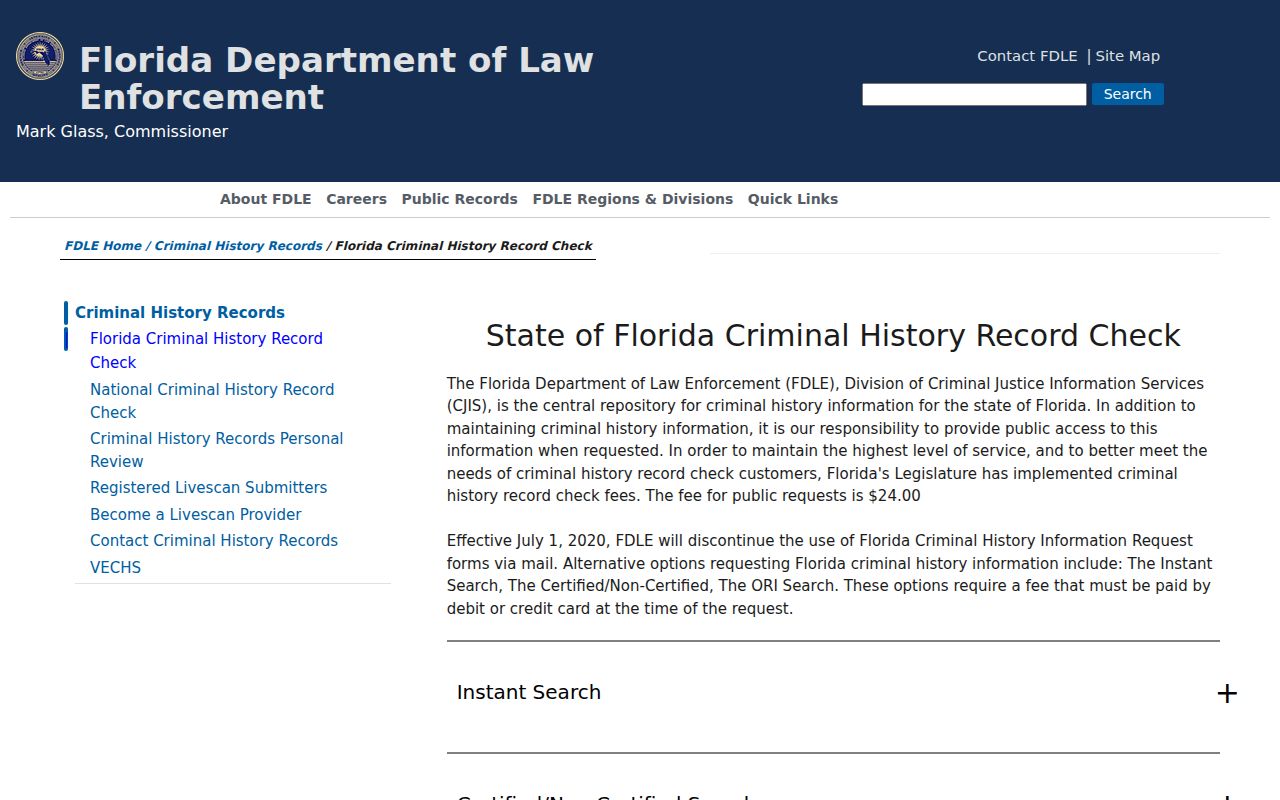
The official screen helps readers choose a product before sending money or personal data.
Fingerprint Review for Duval Records
A person checking their own record should use FDLE Personal Review. Section 943.056 authorizes access and a challenge to incomplete or incorrect repository data. The applicant submits FDLE's form and a fingerprint card taken by a law-enforcement or criminal-justice agency. FDLE charges no personal-review fee. Only the subject or a designated attorney may request it.
The fingerprint card needs the subject's identity data, prints, signature, date, and the taking official's signature and agency mark. The application and original card go by mail to Criminal History Record Maintenance in Tallahassee. If an arrest lacks its outcome, attach certified court or agency records when challenging the entry. FDLE works with the contributing source rather than changing source data without support.
The official Personal Review instructions lay out the subject-only route.
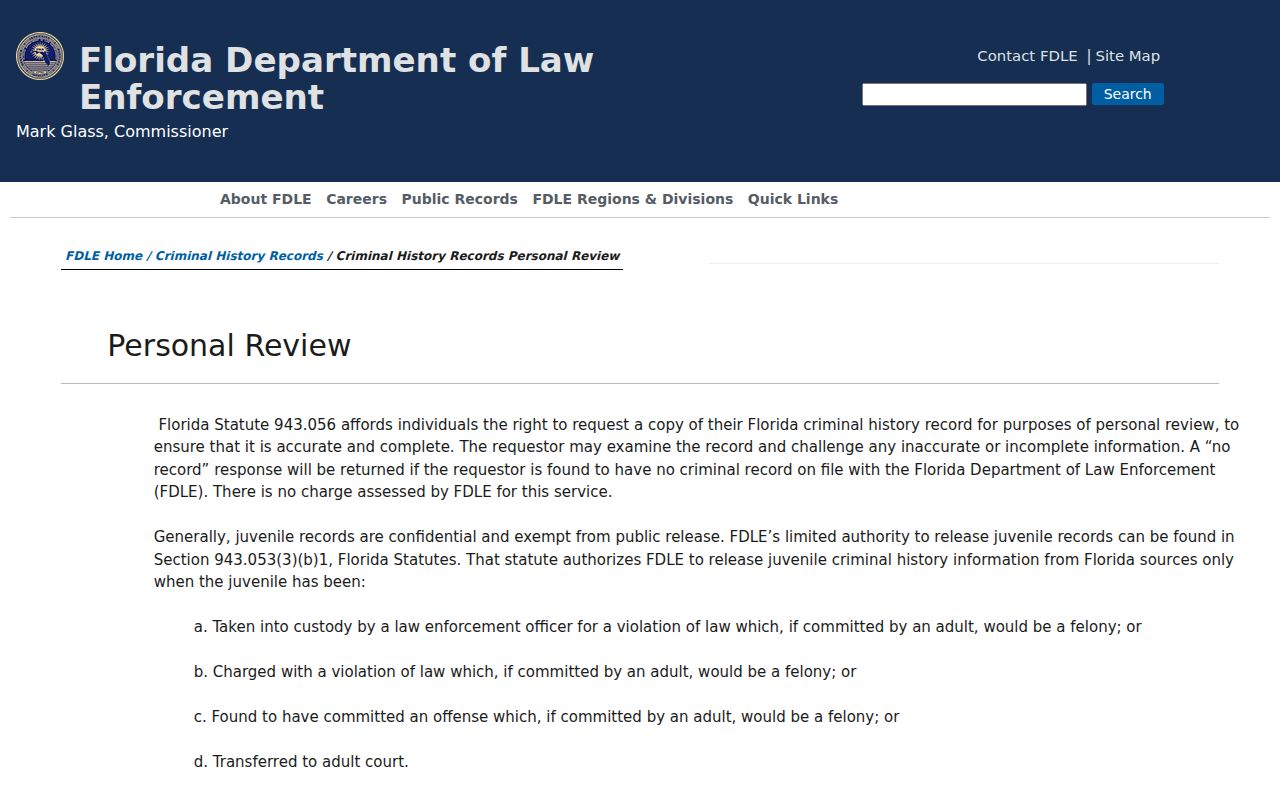
This process is slower than a name search, but fingerprints make it the sound choice for identity and correction work.
Duval County Criminal Record Types
Each Duval County office makes a record for its own part of the case. The arresting agency writes an incident or arrest report. JSO corrections creates the booking and custody entry. The State Attorney decides what to file. The Clerk then records the case, motions, orders, plea, judgment, sentence, and financial obligations. FDLE receives fingerprint arrest data and later disposition reports.
- Police report: the officer's account, event facts, and arrest basis, with lawful redactions.
- Booking record: jail number, intake charge, bond, custody place, and booking data.
- Court file: filed counts, docket events, orders, outcome, and sentence.
- Repository history: reported Florida arrest cycles and dispositions linked through state systems.
- Supervision or registry record: a separate FDC or FDLE public record when legal criteria apply.
A charge is an allegation. A booking is not a conviction, and the lack of a current jail result says nothing conclusive about an older case.
JSO Jail and Booking Records
The JSO Inmate Search supports a name or jail-number search without a stated fee or login. A result may show jail number, booking date, status, facility, arresting agency, intake charge, bond, and a court reference. It does not supply the incident narrative. Request that report from the agency that made the arrest, then use CORE to see filed charges and disposition.
Call 904-630-5760 if a recent intake, release, or spelling issue makes the online result hard to locate. The John E. Goode Pretrial Detention Facility handles most pretrial custody; Montgomery Correctional Center and the Community Transition Center serve different local functions. Once someone transfers to state custody, JSO is no longer the right locator.
Note: Facility staff can address custody operations, but the Clerk controls court copies and JSO Public Records handles agency reports.
Inside a Duval Criminal Record
A Duval County criminal record changes shape as it moves through the system. The repository emphasizes identity and arrest cycles. CORE emphasizes case number, parties, charges, docket events, hearings, documents, disposition, sentence, and money owed. A JSO booking result centers on intake and custody. Public versions omit or redact protected identity, victim, juvenile, medical, financial, and security data.
| Name and identifiers | Legal name, aliases, date of birth, and agency identifiers when public. |
|---|---|
| Arrest data | Arrest date, agency, booking number, intake charge, and bond. |
| Charges | Count description, statute, degree, and filed wording. |
| Disposition | Dismissal, nolle prosequi, acquittal, withhold, or adjudication by count. |
| Sentence | Custody, probation, fines, restitution, and court conditions. |
| Status | Current JSO custody or FDC incarceration and supervision when reported. |
Compare sources by date. A new court order may appear in CORE before the completed arrest cycle reaches FDLE.
Duval Warrants and Court Process
Duval County does not publish a broad official public warrant-name database in the research record. The safer chain is to call JSO at 904-630-0500, contact the relevant court division, and use CORE for case events that may explain a capias or bench warrant. A public-record request can seek an existing nonexempt record, but it cannot force JSO to disclose sealed process or active-investigation details.
A capias is a court order directing an arrest, often after a missed appearance or failure to comply. Do not rely on a third-party people-search result to decide whether one is active. A person addressing their own possible warrant should confirm it with JSO or the court and seek legal advice before arriving unannounced.
Operation Green Light in spring 2025 waived a collection surcharge for some overdue obligations. It was temporary fee relief, not warrant cancellation, sealing, or expunction.
Duval Criminal Record Access Laws
Florida Public Records Law starts with access, but specific exemptions protect information and cases. Ask the actual custodian: JSO or a beach-city police department for its report, the Duval Clerk for a judicial file, and FDLE for repository history. A request does not require a reason, yet a clear date, place, report number, record type, and delivery choice can greatly reduce delay and cost.
Key Florida authorities:
Chapter 119, Florida Statutes gives access to nonexempt state and local records.
Section 943.053 governs FDLE dissemination and public fees.
Section 943.056 provides personal review and challenge rights.
Florida court access rules preserve access while protecting confidential case material.
Ordinary paper copies may cost 15 cents for one side or 20 cents for two sides. Extensive review and redaction can support a reasonable service charge, so request an estimate before authorizing broad video, audio, or email work.
Duval County Custody After Transfer
When local custody ends in a state-prison transfer, use the FDC Offender Search. It can cover incarceration and Florida felony community supervision. County-court probation arrangements may differ, and the court docket remains the best evidence of the sentence imposed. The Florida Commission on Offender Review handles the state's limited parole authority.
The FDC search interface illustrates the custody and supervision layer outside JSO.
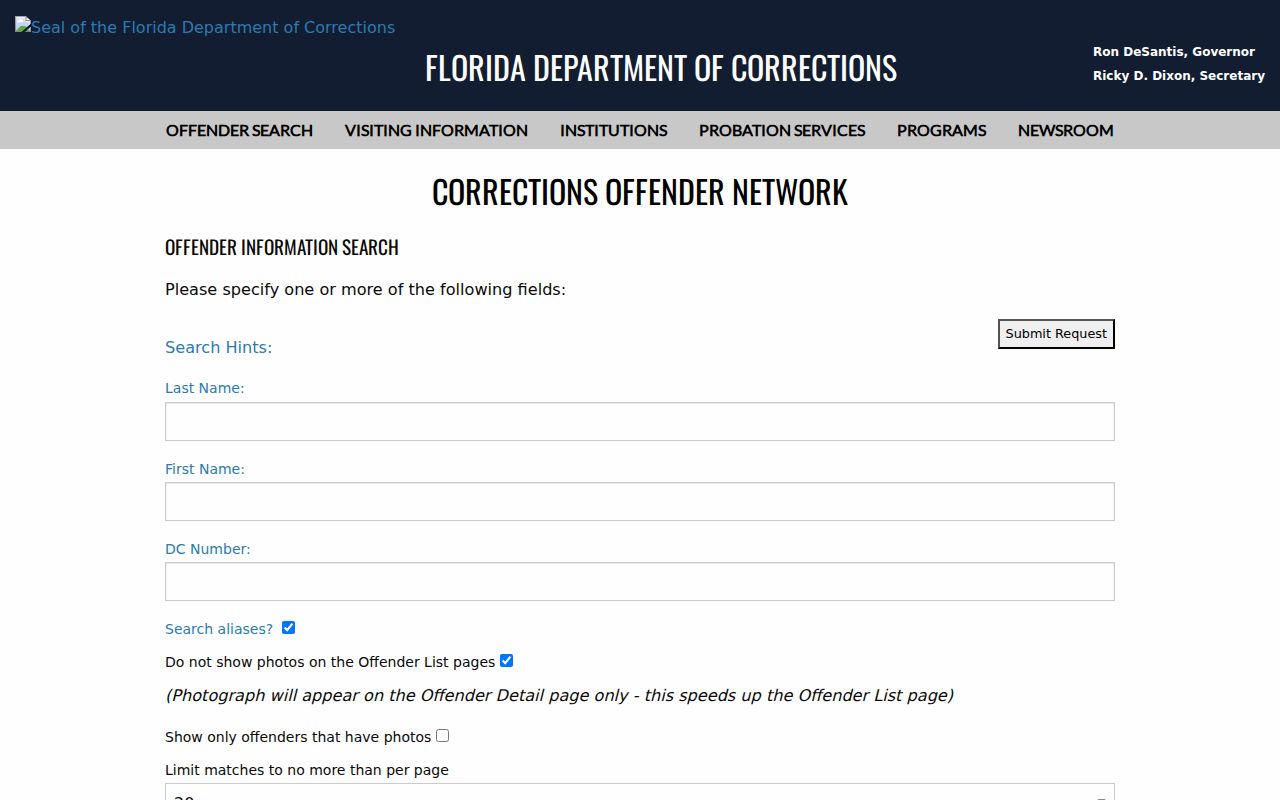
An FDC result should be read with the Duval County court judgment because supervision status does not replace the case file.
Probation is court-ordered community supervision. Parole is conditional release under authority that applies to a narrower set of Florida cases. They are not interchangeable terms.
Restricted Duval Criminal Records
Florida distinguishes sealing from expunction. A sealed record stays intact but leaves ordinary public access. After expunction, local criminal-justice copies are destroyed or removed as the statute directs, while FDLE keeps a limited confidential entry. Neither remedy occurs automatically just because a charge was dropped. Juvenile cases, victim information, active investigative material, and records protected by court order also follow separate rules.
Before seeking relief, keep the arrest report and certified disposition. Review FDLE's denial grounds, obtain a fingerprint card, and submit the $75 Certificate of Eligibility application with the required records. FDLE states about 12 weeks and does not expedite. The certificate only permits a petition; it does not grant relief. The Duval Clerk lists a separate $59 sealing or expungement charge, and the judge retains discretion.
The FDLE relief overview distinguishes the available paths.
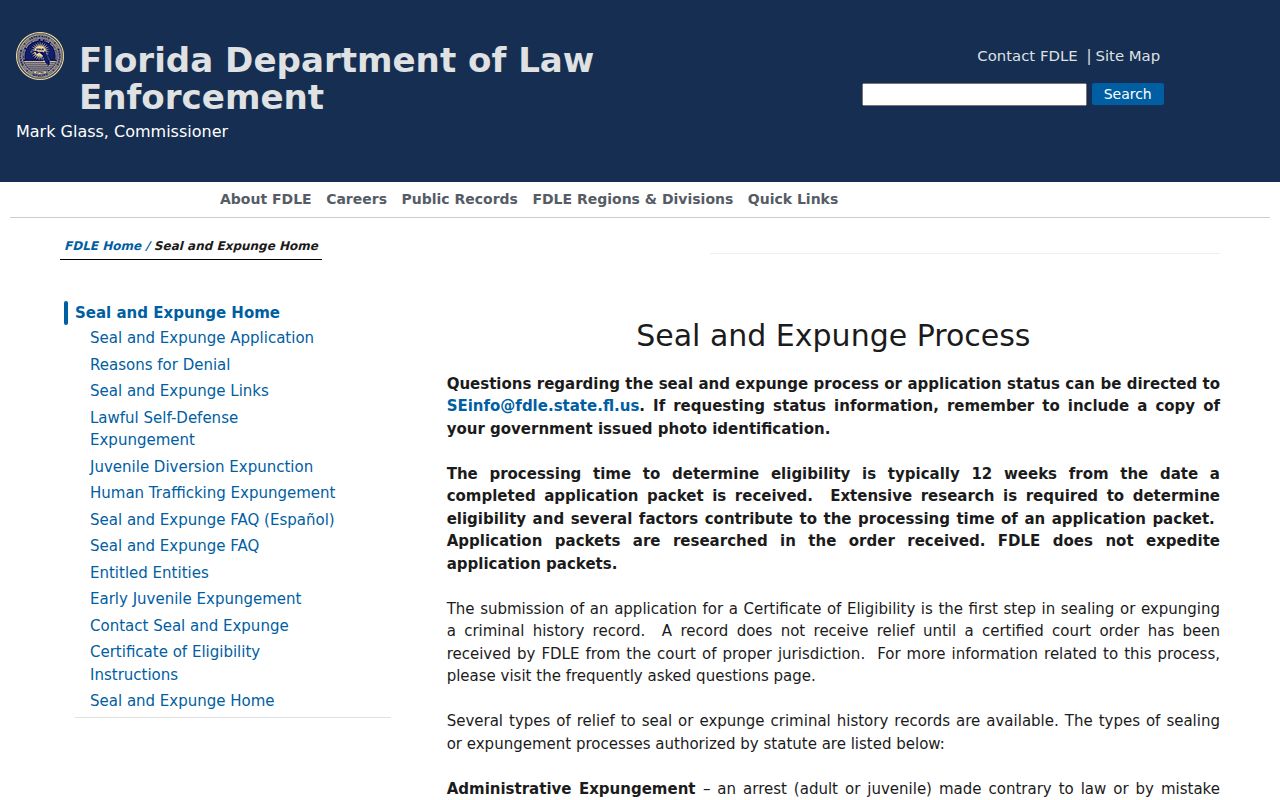
The image is a useful starting point, but eligibility turns on the full case history and the specific statutory remedy.
Federal Cases in Duval County
A federal prosecution may never appear as a Duval state case. PACER holds federal dockets for the Jacksonville Division of the Middle District of Florida, while the federal Bureau of Prisons locator covers federal custody. The FBI Identity History Summary is a subject-only fingerprint product, not a public name search. A federal defendant may also be held temporarily in a JSO facility, so custody and case ownership can split.
The Bryan Simpson U.S. Courthouse page identifies the Jacksonville federal clerk and building.
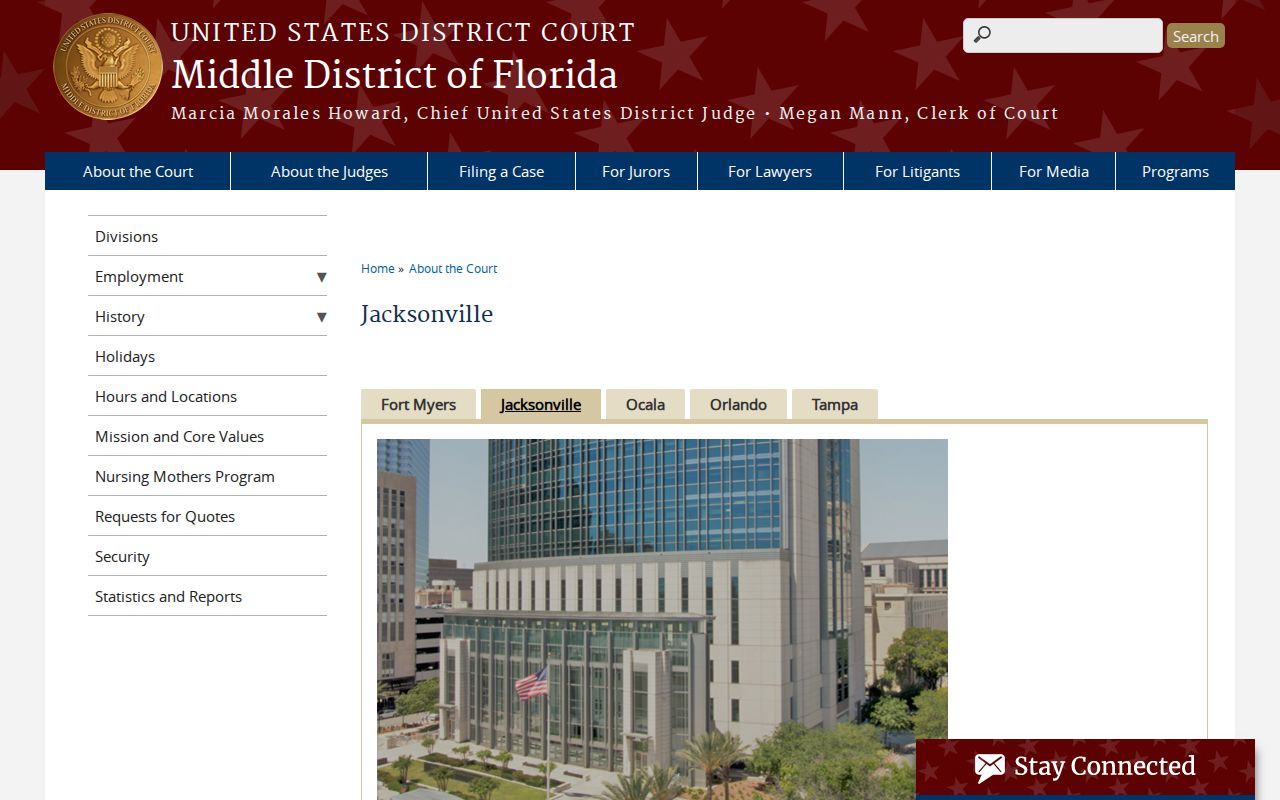
The federal courthouse at 300 North Hogan Street handles Middle District files; PACER remains the remote docket channel.
Duval Criminal Record Terms
Florida docket language can change the meaning of a result. Read the outcome for each count and open the related order when it is public. A short list of common terms helps separate an accusation from the final result.
- Nolle prosequi
- The prosecutor filed a decision not to continue that charge at that time.
- Withhold of adjudication
- The court withheld a formal finding of guilt; it is not a dismissal and can affect relief.
- Disposition
- The outcome of one charge, such as dismissal, acquittal, withhold, or conviction.
- Information
- A prosecutor-filed charging document commonly used in Florida felony cases.
- Capias
- A court-issued command to arrest, often tied to a missed appearance or noncompliance.
One case can contain several counts with different results. Never carry the intake wording forward without checking the filed charge and final disposition.
Duval County City Record Checks
Jacksonville's consolidated government makes JSO both sheriff and city police, but Jacksonville Beach and Atlantic Beach keep their own police records. A beach-city arrest can create three files: the city department's report, JSO's booking entry, and the Duval Clerk's court case. These city guides keep that ownership clear.
Jacksonville Record Check
1,009,833 residents · JSO report, booking, and consolidated police routes.
Jacksonville Beach Record Check
23,630 residents · JBPD records with JSO custody and Duval court routing.
Atlantic Beach Record Check
13,279 residents · ABPD reports, Beaches Branch, and JSO booking links.
The population figures are July 2024 Census estimates. They describe scale, not the chance that any person has a record.